
Darien City Directory Collections
Darien's directory trail is a set of selected holdings rather than one unbroken run. The Bridgeport Public Library History Center finding aid describes a city-directory collection. It reaches from 1855 to 1990. Darien volumes appear across several periods. Those entries power a local search. The aid still names no publisher for every single volume. It identifies Price and Lee Co., North American Directory Publishers, and other creators only at the collection level. A request should name the Darien town, the year, and the volume lead. Promising a publisher up front invites confusion.
| Collection | Years | Where Held | Access |
|---|---|---|---|
| Selected Darien volumes in the Bridgeport finding aid | 1926, 1928, 1930, 1932-33, 1935, 1939, 1944, 1946, 1949 | Bridgeport Public Library History Center | Physical, microfilm, or partial database access; confirm the requested year |
| Mid-century Darien city directories | 1950-1971 | Bridgeport finding-aid collection and local-history leads | Use the finding aid, then ask about the volume or a library copy |
| Later Darien holdings | 1973-1977, 1979, 1982, 1984-1991 | Bridgeport History Center finding aid | Selected years only; availability and format vary |
| Darien-New Canaan-Norwalk telephone directory | 1952-1955 | Library of Congress Darien digital collection | Text, image, PDF, or microfilm metadata; it is not a full directory |
| United States City and Business Directories | About 1749-about 1990 | FamilySearch collection | Account, film, or viewing restrictions may apply |
The named Darien years sit with gaps between them. A gap may mean a missing volume. It may also mean a different edition, or material that was never digitized. The finding aid describes holdings held physically, on microfilm, or partly through genealogy databases. Not every Darien volume is online. Start with your year. Ask the holding library what a Darien researcher can view, copy, or cite.
Darien Library's Directory Shelf
The Darien Library genealogy resource points researchers to the second-floor Research Room and its local-history material. The collection includes Darien High School yearbooks, Darien city directories, genealogical guides, and history for Darien and Noroton Heights. This Darien route is a practical first stop when a name is tied to a school year, an old street, or a family question rather than a current parcel.
Darien reference staff can help with local files that may not be obvious in a catalog. The library is at 1441 Post Road in Darien. Reference service is listed at 203-669-5236, the main number is 203-655-1234, and text reference is 203-439-6372. The Middlesex Genealogical Society also points researchers to the Research Room, Ancestry Library Edition at the library, and FamilySearch access at home or at the library.
The library's genealogy page is the source for its local-history and directory route. Its placement in the Darien record chain matters because a Darien directory question may need a yearbook, a guide, or a vertical file beside the volume itself.
See the Darien Library genealogy page for the local-history and directory resource path.
The library's own image makes the point plainly. A Darien local directory search can begin at a research room down the street, not only at a broad online name search.
Darien City Directory Years
The Darien year pattern is itself a clue. The finding aid lists Darien at 1926, 1928, 1930, 1932-33, 1935, 1939, 1944, 1946, and 1949, with a longer 1950-1971 span after them. Later entries cover 1973-1977, 1979, 1982, and 1984-1991. That sequence is substantial. It is not a claim that every Darien year survives or that every volume carries the same fields.
Darien's wider record history matters. Middlesex Parish formed in 1737. The town incorporated in 1820. From 1895 onward, the finding aid notes, many directories pair alphabetical listings with street listings. A 1946 Sanborn set covers Darien, Noroton, and Noroton Heights as a building record. The Library of Congress telephone run follows in 1952-1955. Different record types, yet together they show why one Darien address may appear under more than one local label.
- 1737: Older family and church records may use Middlesex Parish rather than Darien.
- 1820: Town incorporation establishes the local map and land-record setting used by later address research.
- 1895 onward: Many directory volumes add a street listing alongside the alphabetical section.
- 1946: The Sanborn map supplies a built-environment snapshot for Darien and Noroton locations.
- 1952-1955: The Library of Congress telephone directory supplies a narrower subscriber and telephone trail.
No authority has fixed a first or last Darien publication year. The holding list is the honest stopping point. Check the edition before trusting a gap.
Reading a Darien City Directory
A full Darien volume can carry more than a bare name. The fields shift with the edition. The Bridgeport finding aid describes entries that may list residence, business, official role, occupation, phone, and occasionally spouse or death-date details. The Library of Congress sample is leaner. It carries a surname, given name or initial, street number and name, locality, and exchange or telephone number. Trust what the page prints, not what a modern directory is assumed to hold.
One printed telephone entry reads "Mlinar Elmer J, 20 Phillips La, Darien, 481535." Another pairs Middlesex Road and Noroton Heights with a Darien number. Neither pattern offers an occupation or a spouse. Those details should never be guessed from a phone listing.
| Name | Surname, given name, and sometimes an initial; confirm whether the line is a person, business, or official listing. |
|---|---|
| Address | Street number and name, with a Darien locality label such as Noroton Heights when printed. |
| Telephone | An exchange or telephone number appears in the 1952-1955 Darien phone source; this field is not guaranteed in every city directory. |
| Occupation | Some full directories may include occupation or work information, but the observed phone entry does not. |
| Spouse or owner marks | Some editions may add family or property notation. No owner, renter, or spouse mark was verified in the observed phone pages. |
- Alphabetical listing
- A name-ordered section that can lead from a person to a printed address.
- Street listing
- An address-ordered section. The finding aid says many volumes from 1895 onward include one, but the exact page layout varies.
- Criss-cross directory
- A reverse-style address-to-name source. No verified separate Darien reverse-directory title or year run was located, so do not assume a Darien one exists.
- Abbreviation key
- The edition's own explanation of short forms and marks. Locate it before interpreting a symbol or a local label.
1952 Darien Phone Book Limits
The Library of Congress telephone directory covering 1952-1955 links a historic Darien name to a street and a telephone exchange. It is not a standalone Darien volume, though. Entries carry surname, given name or initial, street number and name, locality, exchange, and telephone number. The item also spans New Canaan and Norwalk, so keep the printed Darien locality label with every citation you take from it.
A complete Darien city directory could add alphabetical and street sections, business and official entries, and richer historical fields, depending on the edition. The phone book cannot support claims about occupation, spouse, household size, or who actually occupied the address. It records subscriber-style entries for a date range, nothing more. Holding that line keeps a family-history search honest and stops a narrow phone clue from hardening into a full household claim.
Cite carefully. Record the exact page, printed locality, street wording, and telephone field. If an entry reads Middlesex Road in Noroton Heights, keep that wording and check it against a Darien map or a later volume instead of quietly modernizing the place label.
Tracing Darien Households by Year
Good Darien family history work rests on three habits. Keep a fixed name, a date range, and a written log. A Darien residents directory can place a person on one street one year. It may show a different street the next. A blank year is murkier. It may signal a missing volume, a move, a changed listing, or an indexing gap. Pair the directory with a local history source. Do not treat any single entry as a complete household record.
- Write down every name form, initial, street spelling, and locality label already known.
- Choose the closest listed Darien year, then check the alphabetical section before the Darien street section.
- Record the page, address, telephone or other printed field, and the edition's abbreviation key.
- Compare the next available volume and a matching census or vital-record lead to test whether the household moved or remained.
- Use the obituary index, church abstract, Library files, or Museum collections to close a life-event gap.
When the question shifts to ownership history at one address, the deed, map, assessor, and permit trail belongs in the Darien previous residents record chain. A directory entry supplies a household lead. It does not replace the land record or prove who lives there now.
Darien Obituaries Start in 1902
The Darien Library obituary index runs from 1902 to the present. Volunteers entered it, so gaps exist. Darien search results arrive by email, and the Reference Desk can supply full text. A notice's date, newspaper, family relationships, or former address helps. It gives a Darien city directory search a sharper starting point.
Treat the index as a lead. It cannot prove that every Darien death notice was published or captured. A missing result may reflect a volunteer gap, a skipped newspaper issue, or a name variation. It may also point to a life event outside the coverage. File the index response beside the directory citation. Then ask Reference for the full text when a source needs checking.
The Darien obituary index resource shows the search route and the Reference Desk contact.
A dated obituary belongs beside the city directory trail because it can explain why a Darien name disappears from one volume and reappears in a later one.
Darien Church Records Before Directories
The FamilySearch catalog for Darien church records describes Spencer P. Mead's Abstract of church records of the town of Darien, county of Fairfield, and state of Connecticut, from earliest records extant to 1850. The catalog names Film 4041 and digital catalog 8199589. That reach predates the town's later printed address sources. It helps when a family name appears before the city directory holdings begin.
Cataloged does not mean viewable. FamilySearch may impose contract, privacy, film, or login restrictions on the images. Check the catalog record first. Then turn to Darien Library or the State Library if the Darien image will not open from home. Remember what the abstract is. It is an event and relationship source, not a street roster. Pair it with a later directory only after names and dates line up.
The Darien church-record catalog is the route to the pre-1850 abstract.
An early church record can serve as the first dated link in a Darien city directory trail that otherwise begins decades later.
Darien Museum and Archive Appointments
The Museum of Darien research library holds local and state-history documents, photographs, and bound volumes. Research staff appointments run Tuesday through Thursday, 11 a.m. to 4 p.m., at 45 Old King's Highway North. Research help costs $25 per hour, and the phone number is 203-655-9233. The Library's genealogy page still points to the Museum's earlier Historical Society catalog, so older Darien descriptions may carry both names.
The Connecticut State Library History and Genealogy guide opens catalog, city-directory, church, cemetery, court, probate, newspaper, old-house, and vital-record routes. Its History and Genealogy contact is 860-757-6580, with CSL.ISREF@ct.gov for reference and CT.Archives@ct.gov for archives questions. Compact and offsite shelving can affect same-day access. Confirm Darien materials before traveling.
For a stubborn Darien city directory gap, ask the local library, the Museum, and the State Library one focused question: which year, format, call number, and copying route applies? Older municipal files not held in any collection can be requested from the responsible custodian under the Connecticut Freedom of Information Act, subject to exemptions. That builds a citation trail without labeling a missing volume as lost.
The Museum research library page lays out the local appointment route.
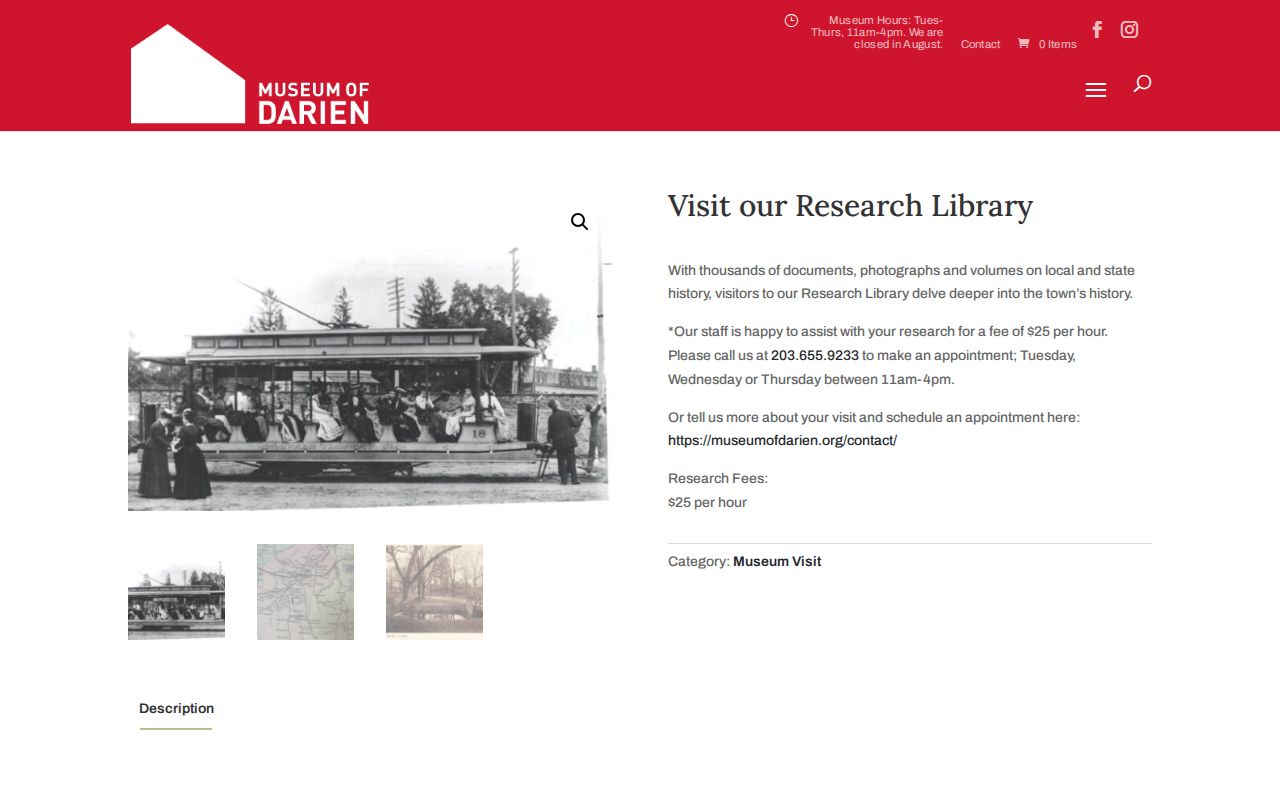
The Museum completes the local research path with photographs, documents, and historical context that printed Darien directories alone cannot supply.